

At a glance
One 900g loaf
ProjectA whole afternoon, and worth clearing it.
- Prep
- 30 min
- Cook
- 45 min
- Total
- 1 hr 15 min
- Serves
- 12
Plus restingFive hours bulk at room temperature, then twelve to fourteen in the fridge.
Sourdough acquired a culture of precision it does not need. Hydration to the gram, folds to the minute, temperature probes, spreadsheets. All of it is real and some of it matters at the margins, but none of it is the difference between good bread and bad bread at home.
The difference is three things: a starter that is actually active, a bulk fermentation judged by looking at the dough, and an oven hot enough.
An active starter
The single most common cause of a dense loaf is a starter used at the wrong moment. Fed and left, a starter rises, peaks, and falls; you want it on the way up or just at the peak, roughly four to eight hours after feeding depending on your kitchen. It should be domed, webbed with bubbles, and smell of yogurt rather than acetone.
If a spoonful floats in water, it is ready. If it sinks, feed it and wait.
Watch the dough, not the clock
Every published bulk time is wrong for your kitchen, because fermentation roughly doubles in speed for every 8C. Five hours at 22C might be three hours in August and seven in an unheated January kitchen. What does not change is what the dough looks like when it is ready: fifty per cent larger, domed rather than flat, wobbling as one mass, with visible bubbles around the rim of the bowl.
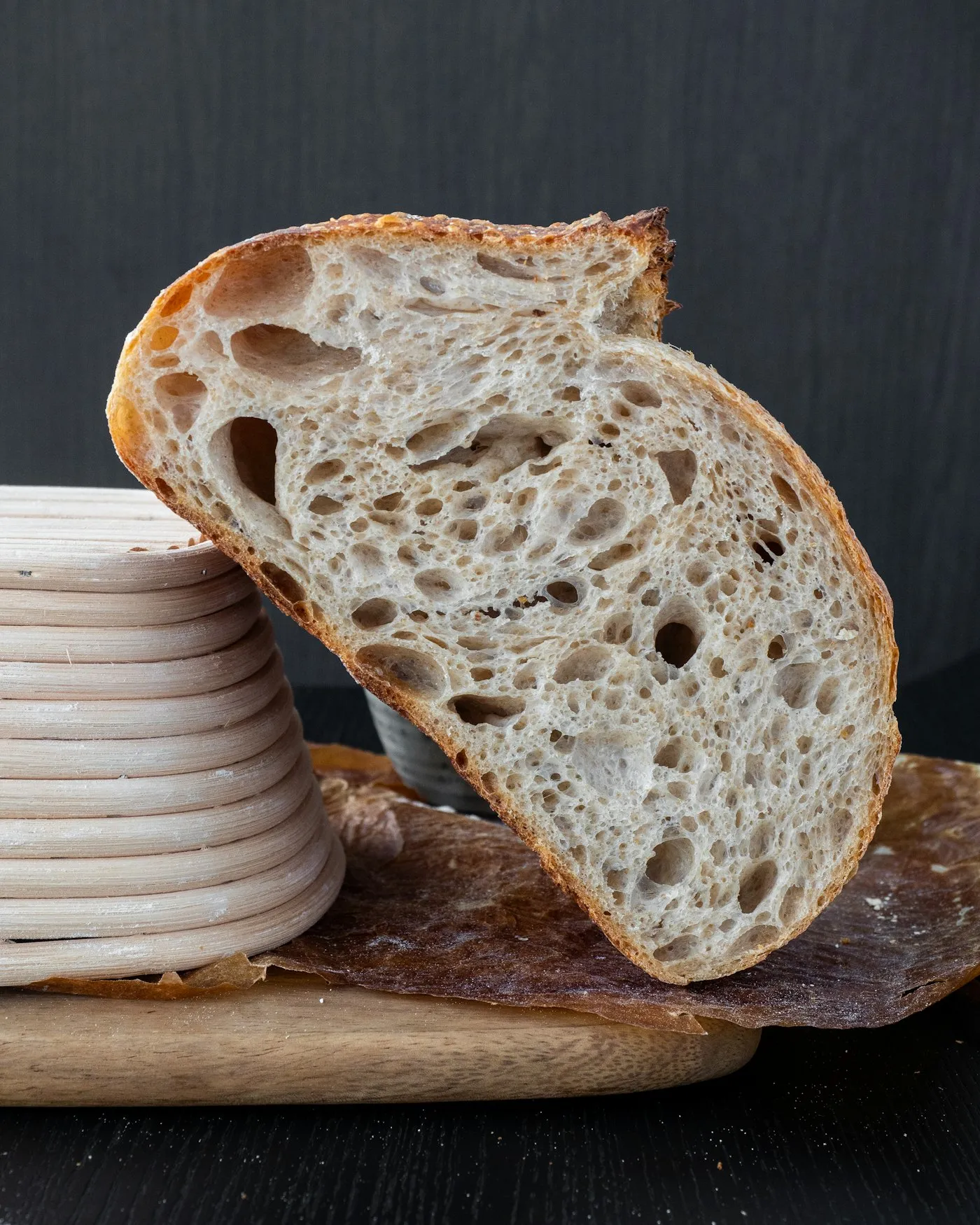
Under-fermented dough bakes tight and pale. Over-fermented dough spreads and tears. Both are visible before the loaf goes in the oven.
The fridge is a scheduling tool
A cold retard slows the yeast almost to a stop while the bacteria carry on producing acid, which is where the sour comes from. It also firms the dough up, which makes it far easier to turn into a screaming-hot pot without deflating.
And it means the loaf waits for you rather than the reverse. Shape at nine in the evening, bake whenever you like the next day.
Bake it dark
Twenty minutes with the lid on traps the loaf’s own steam, which keeps the crust soft so the bread can expand. Then the lid comes off and the crust dries, browns, and finally starts to blister. That last ten minutes — the part that looks like it might be going too far — is where the smell comes from. Take it out when it is the colour of an old penny, not before.
Ingredients
Method
7 steps
Mix everything at once
Stir the starter into the water, add both flours and the salt, and mix with a hand until there is no dry flour. Skip the autolyse — at this hydration it changes very little and costs you an hour.
Four folds over two hours
Every thirty minutes, wet a hand, reach under the dough, stretch it up and fold it over. Turn the bowl and repeat four times. By the fourth set the dough should feel smooth and hold a dome.
Bulk until it is 50% bigger
Cover and leave it for another three hours or so at around 22C. Watch the volume, not the clock — you want half again as big, domed, and jiggly, with bubbles at the edges.
Shape once, gently
Tip it onto an unfloured counter, fold the edges into the middle, flip it over, and drag it in a circle to build tension. Do not knock the air out. Into a rice-floured banneton or a lined bowl, seam up.
Cold retard overnight
Straight into the fridge, uncovered, for twelve to fourteen hours. This is what makes the crumb open and the flavour sour, and it means you bake when it suits you.
Bake from cold, lid on then off
Heat the oven and the empty casserole to 250C for 45 minutes. Turn the cold loaf into it, score one long slash, lid on, 20 minutes. Lid off, drop to 220C, 25 minutes more, until it is properly dark.
Do not cut it hot
Onto a rack for at least two hours. The crumb is still setting; cut at thirty minutes and it will be gummy and you will blame the recipe.
Cook's notes
- Bake it darker than you think. Pale sourdough is underbaked sourdough, and almost all of the flavour in the crust arrives in the last ten minutes.
- Rice flour does not absorb water, so it will not glue the loaf into the banneton the way wheat flour does.
- If the dough is slack and spreads when shaped, the bulk went too long. Shorten it by 45 minutes next time rather than adding flour.
- You will need
- A cast-iron casserole with a lid · Digital scale
- Keeps
- Cut side down on a board, three days. Sliced and frozen, six weeks, and it toasts better than it keeps.